Formats
Daguerreotype restoration
A daguerreotype is the first practical photograph: a mirror-polished silvered copper plate sealed under glass in a hinged case. Each one is unique, with no negative behind it.
Tarnish creeps in from the edges as a blue-brown halo, the cover glass weeps and etches, and the image appears or vanishes depending on the angle you hold it at. Most of what goes wrong with a daguerreotype is on the surface, and the image underneath is usually recoverable from a good scan.
Start with Tintype & Daguerreotype Restoration for the daguerreotype, then add Scratch & Tear Repair or Stain & Spot Remover for anything it leaves behind. The 4 free credits on a new account cover one Standard pass on a daguerreotype.
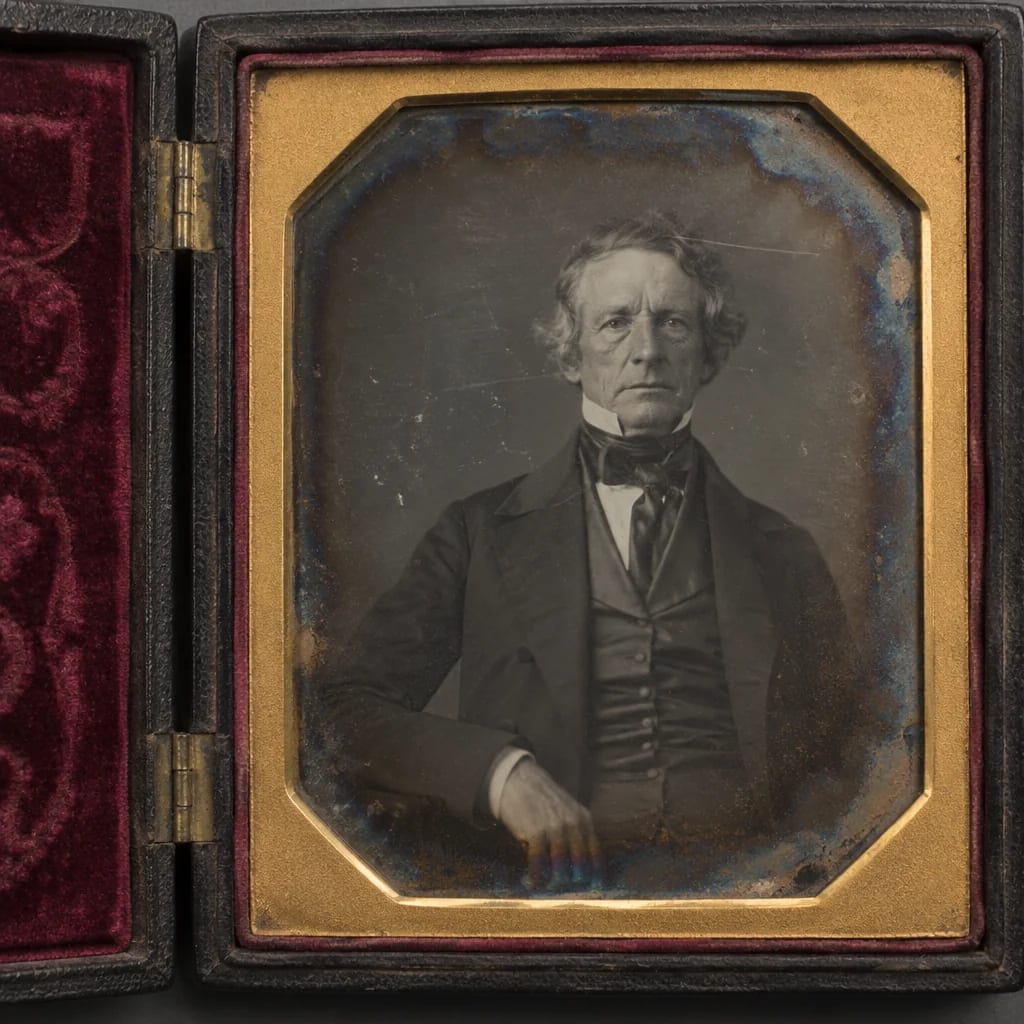
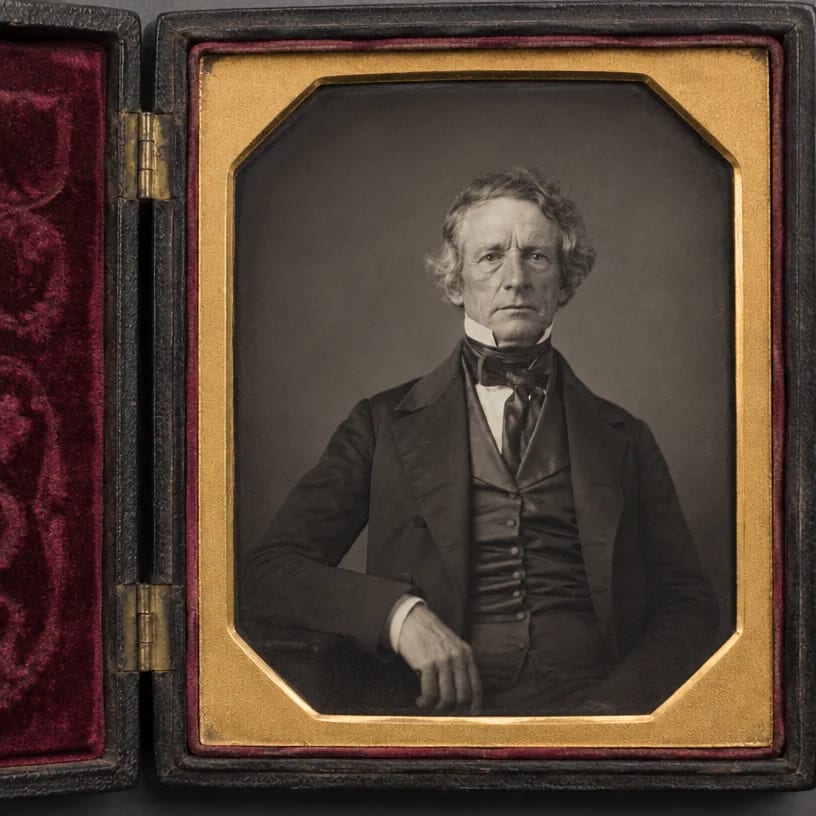
Original on the left, restored on the right; hover to see more of the repair. Made in the Studio from a scan of the print.
Print and file requirements
| Requirement | Detail |
|---|---|
| Years in use | 1839 to about 1860 |
| Typical size | Sixth-plate 2.75 x 3.25 in; quarter-plate 3.25 x 4.25 in |
| Process | Silver-plated copper sensitized with iodine, developed in mercury vapor |
| Appearance | Mirror-like; positive or negative depending on the viewing angle; held in a case |
| How it fails | Edge tarnish rings, glass deterioration, wiped surface (irreversible) |
| Scan tip | Never open the seal or touch the plate; photograph through the glass with a black card to kill reflections |
What matters for these photos
- Edge tarnish rings, glass deterioration, wiped surface (irreversible) on a daguerreotype
- A daguerreotype scanned once, badly, and never touched again
- Faces on a daguerreotype that are too small or too soft to enlarge
- A reprint of the daguerreotype for a frame, needing more pixels than the scan has
Suggested order of passes
- 01
Run Tintype & Daguerreotype Restoration on the daguerreotype
Written for the way a daguerreotype fails: edge tarnish rings, glass deterioration, wiped surface (irreversible).
Tintype & Daguerreotype Restoration - 02
Clean up the daguerreotype scan
Removes scanner dust, borders and the color cast a flatbed adds to a daguerreotype, and straightens it.
Scan Cleanup - 03
Restore the faces on the daguerreotype
Recovers eye and skin detail at natural strength; small faces on a daguerreotype are plausible reconstructions.
Face Restoration - 04
Upscale the daguerreotype for reprinting
A daguerreotype is small to begin with; the upscaler adds the pixels a frame-sized print needs.
Image Upscaler
Questions
Related guides