Formats
Ambrotype restoration
An ambrotype is a collodion negative on glass backed with black varnish, paper or cloth so that it reads as a positive. It was cased like a daguerreotype but without the mirror shine, and it was cheaper.
The black backing flakes and lets light through as bright patches, the collodion peels away from the glass, and the glass itself cracks. None of this is reversible on the ambrotype itself, which is why the repair happens on a scan while the original goes back into a cool, dry box.
Run Tintype & Daguerreotype Restoration on the ambrotype scan first, then decide whether the result needs a second pass for faces or grain. A ambrotype restored at Pro or Max holds up better as a large reprint.
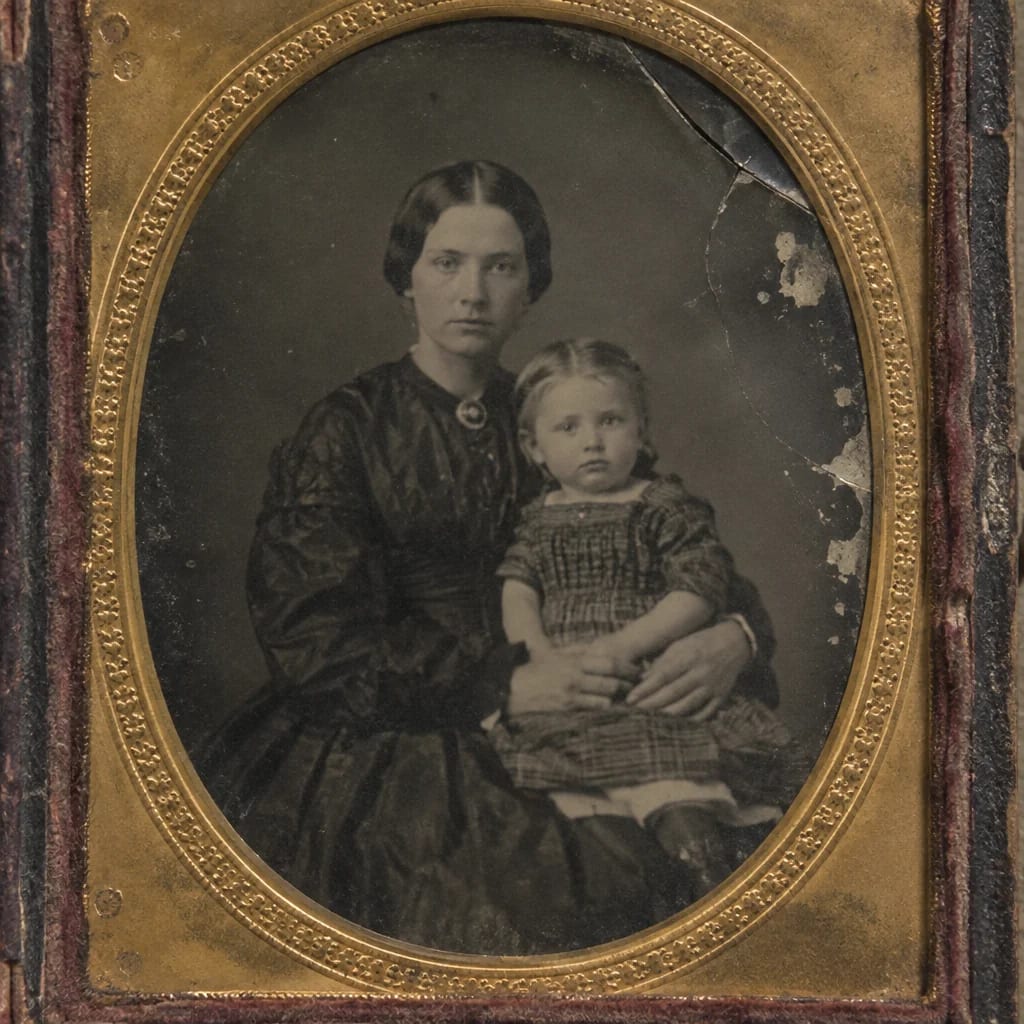
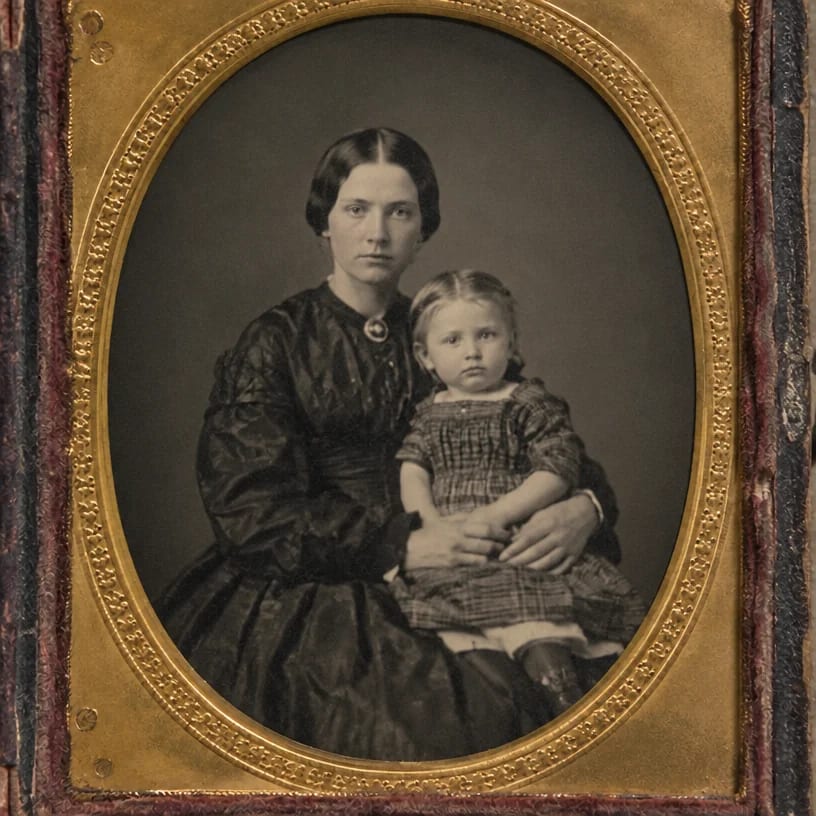
Original on the left, restored on the right; hover to see more of the repair. Made in the Studio from a scan of the print.
Print and file requirements
| Requirement | Detail |
|---|---|
| Years in use | 1854 to about 1865 |
| Typical size | Sixth-plate 2.75 x 3.25 in; also ninth-plate and quarter-plate |
| Process | Underexposed wet collodion negative on glass, viewed against a dark backing |
| Appearance | Soft greys, no mirror effect, usually in a hinged case |
| How it fails | Flaking black backing, peeling collodion, cracked glass |
| Scan tip | Keep the plate in its case and photograph it flat on a dark surface |
What matters for these photos
- Flaking black backing, peeling collodion, cracked glass on a ambrotype
- A ambrotype scanned once, badly, and never touched again
- Faces on a ambrotype that are too small or too soft to enlarge
- A reprint of the ambrotype for a frame, needing more pixels than the scan has
Suggested order of passes
- 01
Run Tintype & Daguerreotype Restoration on the ambrotype
Written for the way a ambrotype fails: flaking black backing, peeling collodion, cracked glass.
Tintype & Daguerreotype Restoration - 02
Clean up the ambrotype scan
Removes scanner dust, borders and the color cast a flatbed adds to a ambrotype, and straightens it.
Scan Cleanup - 03
Restore the faces on the ambrotype
Recovers eye and skin detail at natural strength; small faces on a ambrotype are plausible reconstructions.
Face Restoration - 04
Upscale the ambrotype for reprinting
A ambrotype is small to begin with; the upscaler adds the pixels a frame-sized print needs.
Image Upscaler
Questions
Related guides